A small business can report increasing sales, secure new customers and still struggle to pay its suppliers. The problem is often not the amount of revenue generated but the timing of money entering and leaving its bank account.
A realistic budget forecast helps UK small and medium-sized enterprises anticipate that pressure before it disrupts operations. Rather than simply estimating annual profit, it shows when customers are expected to pay, which expenses cannot be postponed and how much cash will remain after each month’s commitments.
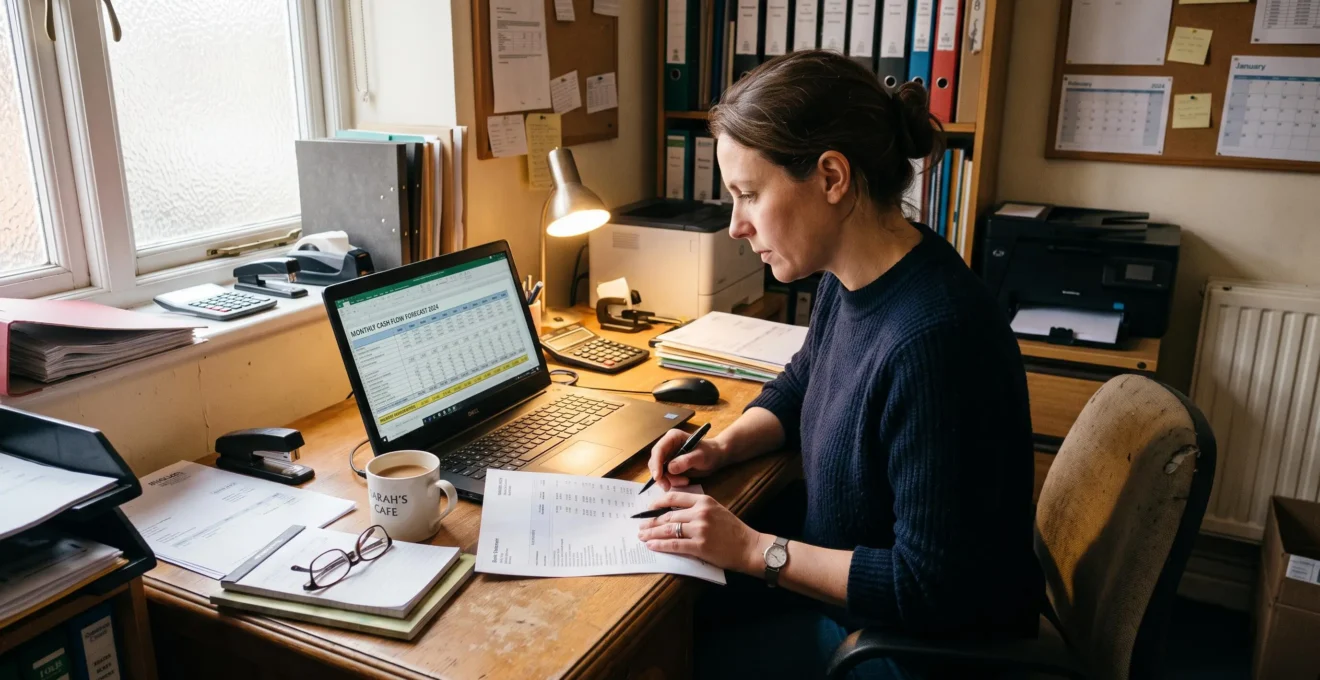
The most useful approach combines a 12-month cash flow forecast, regular comparisons with actual bank transactions and alternative scenarios for slower sales or delayed payments.
This does not require sophisticated financial software. A structured spreadsheet can provide sufficient visibility for many smaller businesses, provided its assumptions are updated and its figures reflect actual payment dates.
The objective is straightforward: identify future shortfalls early enough to adjust spending, collect outstanding invoices or arrange suitable financing without making decisions under unnecessary pressure.
Small business cash forecasting: the essentials
- Forecast actual cash receipts and payments, not just sales and accounting profit.
- Track the closing cash balance across 12 months and test less favourable scenarios.
- Update forecasts when payment patterns, costs or business plans change, rather than waiting until year-end.
- Why Can a Growing Business Face Cash Pressure Despite Rising Sales?
- How Can You Create a 12-Month Budget Forecast in a Simple Spreadsheet?
- Fixed Budget or Rolling Forecast: Which Works Better for a Small Business?
- Which Hidden Costs Most Often Break a Small Business Budget?
- When Should a Business Reforecast Instead of Waiting for Year-End?
- How Can Accounting Support Improve Business Planning and Cash Decisions?
- Why Can the Wrong Type of Finance Hurt a Growing Business?
- How Can a UK Small Business Choose the Right Type of Financing for Its Next Step?
Why Can a Growing Business Face Cash Pressure Despite Rising Sales?
A growing business can experience cash shortages because sales revenue and customer payments occur at different times. New orders often require immediate spending on staff, materials and suppliers, while customers may pay weeks or months later. Growth therefore increases working capital requirements before the additional revenue reaches the bank account.
Consider a hypothetical UK wholesaler that secures £30,000 in additional orders. To fulfil them, it must purchase £18,000 of stock and pay £5,000 in additional operating costs. Customers are expected to settle their invoices after 60 days.
Although the orders appear commercially attractive, the business must find £23,000 before receiving the corresponding customer payments.
If several orders arrive together, this funding requirement increases.
Profitable growth is not necessarily self-financing growth. A business can generate positive accounting margins while exhausting the cash available to fulfil its next order.
Customer payment terms of 30, 60 or 90 days may create substantial differences in cash requirements, depending on the contracts and actual payment behaviour.
Owners should therefore monitor several early warning indicators:
- Debtor days: customers taking longer to settle invoices than previously.
- Overdraft usage: an increasing reliance on borrowing to cover routine expenses.
- Supplier payment delays: invoices being postponed despite satisfactory sales.
- Profit-to-cash differences: reported profits increasing without a corresponding improvement in available cash.
A less obvious consequence is the loss of commercial opportunities. A business unable to purchase materials or recruit additional staff may decline otherwise profitable contracts.
The solution is not necessarily to reduce growth. It is to forecast the cash required to support that growth and ensure sufficient funding is available when expenditure falls due.
The next step is to translate these timing differences into a monthly forecast that exposes potential shortages before they affect operations.
How Can You Create a 12-Month Budget Forecast in a Simple Spreadsheet?
To create a 12-month budget forecast, start with the current bank balance, estimate cash receipts and payments for each month, and calculate the closing balance after every period. Separate expected customer payments from invoiced sales, include tax obligations and test alternative scenarios. The resulting spreadsheet should reveal when cash may become insufficient.
A practical forecast can be built in Excel, Google Sheets or another spreadsheet application.
The Business.gov.uk guidance on preparing funding applications describes a 12-month cash flow forecast covering expected income, expenditure and the running balance remaining at the end of each month.
The distinction between invoicing and receiving payment is particularly important. A £10,000 invoice issued in January but expected to be paid in March belongs in March’s cash receipts.
Build the spreadsheet around actual cash movements
Begin with the previous 12 months of bank statements. Identify recurring payments, seasonal changes, irregular expenses and the actual dates on which customers settle invoices.
Create one column for each forecast month and separate rows for:
- Opening cash balance.
- Customer receipts and other expected cash inflows.
- Payroll, rent and other fixed commitments.
- Stock, materials and other variable payments.
- Tax payments, financing costs and capital expenditure.
- Closing cash balance.
The central calculation is:
Closing cash = Opening cash + Cash received − Cash paid.
The closing balance then becomes the following month’s opening balance.
The following figures are entirely hypothetical and illustrate a simplified three-month forecast.
| Cash flow item | January | February | March |
|---|---|---|---|
| Opening cash | £15,000 | £11,000 | £2,000 |
| Cash received | £20,000 | £18,000 | £28,000 |
| Cash paid | £24,000 | £27,000 | £22,000 |
| Closing cash | £11,000 | £2,000 | £8,000 |
Although cash remains positive, February leaves very little flexibility for an unexpected expense.
Include UK tax deadlines and alternative scenarios
Tax payments should appear in the month they are actually due.
Under the ordinary payment timetable, Corporation Tax is generally payable nine months and one day after the relevant accounting period ends. Companies subject to instalment arrangements follow different rules, as explained in HMRC‘s Corporation Tax payment guidance.
VAT-registered businesses commonly submit quarterly VAT Returns, with the standard filing and payment deadline generally one calendar month and seven days after the VAT period ends. The actual timetable and net amount payable depend on the business’s VAT arrangements.
PAYE and National Insurance payments must also be scheduled according to the employer’s applicable payment arrangements.
Once these commitments are entered, create three versions of the forecast:
- Central: expected sales, payment behaviour and costs.
- Pessimistic: slower collections, weaker demand or higher expenditure.
- Optimistic: stronger receipts without assuming every payment arrives immediately.
The pessimistic scenario is particularly valuable because it identifies decisions that may be needed before a shortage occurs.
Five actions to complete your first cash forecast
- Export 12 months of bank transactions and produce a categorised historical cash summary.
- Create 12 monthly columns with separate receipt and payment rows, producing a working forecast spreadsheet.
- Enter customer payment dates and contractual commitments, producing a dated cash movement schedule.
- Add tax deadlines and three scenarios, producing a comparison of projected monthly closing balances.
- Identify the lowest projected cash balance and document one corrective action for each potential shortfall.
Once the spreadsheet exists, the next decision is whether to preserve it as a fixed annual plan or update its forecast horizon continuously.
Fixed Budget or Rolling Forecast: Which Works Better for a Small Business?
A fixed annual budget works best as a reference for financial targets and spending commitments, while a rolling forecast is better suited to monitoring changing cash conditions. Businesses with seasonal demand, unpredictable customer payments or rapid growth generally benefit from regular forecasting updates. Many SMEs can use both without maintaining two complicated financial systems.
A fixed budget records the assumptions approved at the start of a financial period. It provides a stable benchmark for evaluating performance, controlling departmental spending and communicating financial targets.
A rolling forecast updates assumptions as new information becomes available. For example, after January ends, actual January figures replace estimates and a new future month is added to preserve the 12-month horizon.
The two methods answer different questions:
| Decision factor | Fixed annual budget | Rolling forecast |
|---|---|---|
| Main purpose | Set financial targets | Anticipate future outcomes |
| Update frequency | Usually retained as a baseline | Typically updated monthly |
| Best suited to | Stable, predictable activity | Variable demand or payment timing |
| Main limitation | Assumptions may become outdated | Requires regular maintenance |
| Cash management value | Provides an initial reference | Reflects changing cash expectations |
A business with recurring contracts and predictable costs may find an annual budget, supported by quarterly cash reviews, adequate.
A seasonal retailer, construction subcontractor or rapidly expanding service company may need monthly updates because changes in customer receipts or supplier costs can quickly alter its cash position.
The main risk of relying exclusively on a fixed budget is treating outdated assumptions as current predictions.
If a major customer delays payment, comparing results against the original annual budget does not reveal whether payroll can still be covered in six weeks.
Maintaining a rolling forecast need not be burdensome. Each month, the owner can replace estimates with actual transactions, revise expected receipts and extend the forecast by one month.
The annual budget remains useful as a performance benchmark, while the rolling forecast supports operational decisions.
Whichever approach is adopted, forecasts become unreliable when recurring but overlooked expenses are excluded from the calculations.
Which Hidden Costs Most Often Break a Small Business Budget?
Small business budgets frequently underestimate costs that occur irregularly, increase with sales or remain outside routine accounting reviews. Software renewals, equipment replacement, administrative work, payment processing fees and unpaid customer invoices can all reduce available cash. UK tax obligations and employment cost changes create additional pressure when their timing or financial impact is overlooked.
These expenses are not necessarily unexpected. Many are predictable but absent from the original assumptions.
Costs that are easy to underestimate
Common categories include:
- Administrative work: time spent on invoicing, regulatory compliance, payroll administration and debt collection.
- Software subscriptions: annual renewals, additional licences and upgrades.
- Banking charges: transaction fees, foreign exchange costs and borrowing charges.
- Equipment expenditure: servicing, repairs and eventual replacement.
- Bad debts: invoices that customers may never settle.
Administrative time may not always create a separate bank payment, particularly when the owner performs the work. Nevertheless, it consumes capacity that could otherwise support revenue-generating activity.
Forecasts should distinguish this opportunity cost from actual cash expenditure.
Why successful sales can generate additional costs
Growth creates variable costs that a historical budget may fail to capture.
Higher transaction volumes can increase card processing charges. Additional employees increase payroll administration requirements. More orders may require larger stock purchases, creating the risk of unsold inventory.
A forecast based solely on last year’s spending can therefore underestimate the costs associated with next year’s projected sales.
UK businesses must also anticipate changes in employment costs, including applicable National Minimum Wage rates and employer National Insurance contributions.
VAT compliance, including Making Tax Digital requirements where applicable, may generate software or administrative costs.
For sole traders, Income Tax payments on account can create substantial scheduled cash commitments when applicable.
The amounts and deadlines should be checked against the business’s actual circumstances rather than estimated using a generic percentage.
Use monthly variance analysis to find omissions
At the end of each month, compare actual payments against forecast expenditure.
Classify material differences into three categories:
- Incorrect assumptions, such as higher-than-expected supplier prices.
- Omitted costs, such as an annual subscription renewal.
- Exceptional events, such as an unexpected equipment repair.
Recurring omissions should become permanent forecast lines. Exceptional costs should inform contingency planning without automatically being treated as regular monthly expenditure.
Recognising these costs is useful only if the business updates its forecast early enough to respond.
When Should a Business Reforecast Instead of Waiting for Year-End?
A business should reforecast whenever new information materially changes expected cash receipts, expenditure or funding requirements. Significant customer payment delays, major contract changes, rising costs and investment decisions are common triggers. If projected cash becomes negative within the next three months, forecasting should immediately support operational decisions rather than remain a routine reporting exercise.
Waiting until year-end can leave insufficient time to reduce expenditure, renegotiate commitments or arrange finance.
A monthly review provides a practical baseline, but material changes should trigger earlier revisions.
Recognise events that justify an immediate update
Examples include:
- Actual customer receipts falling below expectations for two or three consecutive months.
- Winning or losing a customer representing a significant share of turnover.
- A substantial change in energy, payroll or supplier costs.
- Plans to recruit, acquire equipment or enter a new market.
- A major customer becoming overdue or showing signs of financial difficulty.
The importance of a change depends on the company’s cash reserves, operating margins and existing obligations.
A small deviation may be manageable for a business with substantial liquidity but critical for one operating close to its overdraft limit.
Forecast in greater detail as cash pressure approaches
The next three months generally deserve more precise attention than distant periods.
When liquidity becomes tight, a weekly cash schedule can show whether receipts will arrive before payroll, rent or supplier payments become due.
Longer-term months can continue to use broader assumptions until more reliable information becomes available.
Consider a hypothetical business whose forecast shows a £7,000 shortfall eight weeks ahead.
It may still have time to contact overdue customers, negotiate payment schedules, postpone discretionary expenditure or discuss finance with its lender.
If the same shortage is discovered days before payroll, those options become considerably more limited.
Reforecasting preserves decision-making time. It does not eliminate financial pressure, but it makes corrective action possible before a temporary shortage becomes an immediate crisis.
Reliable updates also depend on the quality and timeliness of the underlying accounting records.
How Can Accounting Support Improve Business Planning and Cash Decisions?
Accounting support improves financial planning by keeping transaction records current, identifying tax commitments and helping business owners interpret financial performance. A bookkeeper maintains reliable financial data, an accountant provides technical analysis and compliance guidance, and the owner contributes commercial assumptions. Together, these inputs make cash forecasts more accurate and decisions more informed.
A forecast cannot be reliable when its underlying records are several months out of date.
If supplier invoices, customer payments and payroll costs have not been recorded promptly, the business may underestimate outstanding liabilities or overestimate future receipts.
Understand who contributes what
The bookkeeper typically records transactions, reconciles bank accounts and maintains customer and supplier balances.
An accountant can review financial performance, advise on tax obligations, assess forecast assumptions and help interpret the implications of financing decisions.
The business owner remains responsible for commercial expectations, including planned recruitment, pricing changes, potential contracts and anticipated customer demand.
Financial forecasting is a shared process, not a task that can be delegated entirely.
Even an experienced accountant cannot reliably predict future sales without current information from the people managing the business.
Cloud accounting tools such as Xero or QuickBooks can help maintain up-to-date records, although the accuracy of the forecast still depends on correct entries and sensible assumptions.
Choose support according to business complexity
A micro-business with straightforward transactions may benefit from outsourcing routine bookkeeping and obtaining periodic accounting advice.
A growing business with more employees, complex VAT arrangements or substantial customer credit exposure may benefit from regular bookkeeping support combined with quarterly accountant reviews.
An accountant can also help estimate future Corporation Tax, VAT and PAYE liabilities, allowing these obligations to be included in the forecast before payment deadlines arrive.
HMRC’s guidance on VAT Returns confirms that quarterly reporting is the usual arrangement and that the standard deadline is generally one calendar month and seven days after the VAT period ends. Businesses should check their own deadlines and expected net liabilities rather than assume every return produces a payment.
The cost of professional support should be compared with the owner’s time savings, improved financial visibility and reduced risk of errors.
Once those foundations are established, the business can evaluate whether external financing is appropriate and what risks different funding arrangements introduce.
Why Can the Wrong Type of Finance Hurt a Growing Business?
The wrong financing arrangement can increase cash pressure when repayment terms do not match the business’s underlying funding requirement. Short-term borrowing may become expensive when used continuously for recurring operating losses, while long-term debt can create unnecessary commitments for temporary needs. Fees, guarantees and contractual restrictions can further reduce financial flexibility.
The first distinction is between a temporary cash timing problem and an underlying inability to generate sufficient cash.
A profitable business waiting for customers to pay may need short-term working capital support.
A business consistently spending more than it receives, without a credible path to improvement, has a different problem.
Borrowing can bridge a timing gap, but it does not automatically correct a structurally unprofitable business model.
Match the funding instrument to the requirement
An overdraft or invoice finance arrangement may be relevant to short-term fluctuations in working capital.
Equipment purchases may be better suited to asset finance or leasing arrangements that spread payments over the useful life of the asset.
Longer-term expansion may justify a term loan or equity investment, depending on expected returns, repayment capacity and the owner’s willingness to share control.
Each option introduces different risks.
Small business lending agreements may include arrangement fees, personal guarantees, early repayment charges or financial covenants.
Equity investment generally avoids scheduled debt repayments but dilutes ownership and may give investors influence over important business decisions.
The precise consequences depend on the agreement.
Stress-test repayment capacity before committing
Suppose a hypothetical business expects monthly free cash of £4,000 after operating payments and necessary investment.
A proposed loan requires monthly repayments of £2,500.
The central forecast appears to support the repayments, but a pessimistic scenario showing only £1,500 of available cash would indicate a potential funding problem.
This comparison is illustrative, not a universal lending threshold.
Owners should consider whether the business can meet repayments under plausible adverse conditions while retaining enough liquidity for essential operations.
A lender’s approval does not replace that assessment.
The appropriate next step is to select financing according to the purpose, duration and expected cash consequences of the planned investment or shortfall.
Key takeaways before choosing finance
- Identify whether the funding need is temporary, recurring or linked to a long-term investment.
- Check repayment affordability against the pessimistic cash forecast, not only expected sales.
- Assess contractual obligations and ownership consequences alongside the amount of funding offered.
How Can a UK Small Business Choose the Right Type of Financing for Its Next Step?
A UK small business should choose financing by matching the funding term and repayment structure to the purpose of the money. Short-term cash gaps may suit overdrafts or invoice finance, equipment purchases may justify asset finance, and longer-term expansion may require loans or equity. The decision should follow a realistic cash forecast showing affordability under less favourable conditions.
Financing options should be compared according to the nature of the requirement, rather than simply the amount available.
| Business requirement | Potential financing | Main consideration |
|---|---|---|
| Temporary cash timing gap | Overdraft | Borrowing cost and facility availability |
| Unpaid customer invoices | Invoice finance or factoring | Eligible invoices, fees and customer arrangements |
| Equipment or machinery | Asset finance or leasing | Payment schedule, asset terms and total cost |
| Longer-term business growth | Business loan | Repayment affordability and contractual obligations |
| High-risk expansion | Equity investment | Ownership dilution and investor rights |
Explore available UK funding routes
The British Business Bank provides information about financing options available to UK businesses, including different forms of debt and equity funding.
The government-backed Start Up Loans programme is another potential route for eligible applicants starting or developing a young business.
According to Business.gov.uk’s Start Up Loan application guidance, the published programme offers borrowing between £500 and £25,000, with repayment periods of one to five years.
The programme is structured as an unsecured personal loan, rather than a conventional business loan, and requires a credit assessment. Published eligibility conditions and borrowing terms should be checked before applying.
Applicants are required to prepare a business plan and a 12-month cash flow forecast, demonstrating why financial planning is central to funding applications.
The Bank Referral Scheme may provide another route for eligible businesses declined finance by participating banks. Alternative finance providers may also offer relevant products, although their suitability and terms require individual assessment.
Equity funding, potentially involving investors using qualifying SEIS or EIS tax relief arrangements, is a different proposition from borrowing. Eligibility for those schemes depends on specific company, investor and investment conditions.
Prepare a credible financing case
Before approaching lenders or investors, businesses should establish:
- The exact amount required and its intended use.
- The period over which the money will be needed.
- Up-to-date accounts and evidence supporting commercial assumptions.
- A 12-month cash flow forecast incorporating the proposed funding.
- A pessimistic scenario showing how repayments or funding needs would be managed if performance deteriorates.
Debt financing should appear in the forecast through its actual cash inflows, fees, interest payments and principal repayments.
Equity investment should appear as a financing inflow without inventing loan repayments, while its ownership and governance consequences are evaluated separately.
Invoice finance assumptions should reflect the quality of receivables, the provider’s eligibility rules and the timing of advances and settlements.
A well-prepared forecast makes the funding discussion more specific. Instead of requesting a general financial cushion, the owner can explain which payments create the requirement, when the shortage is expected and how future cash receipts are anticipated to support the arrangement.
It also helps identify situations where financing is not the best first response. Improving collections, renegotiating supplier terms or postponing discretionary investment may sometimes reduce the funding requirement without introducing additional financial commitments.
The practical next step is to update the forecast with current bank balances, confirmed liabilities and realistic receipt dates, then compare financing proposals against the lowest projected cash position. A decision based on those figures is more defensible than one driven by sales growth alone.
How much cash should a small business keep in reserve?
There is no single reserve amount suitable for every UK SME. The appropriate buffer depends on payroll commitments, fixed costs, customer payment patterns, seasonality and access to finance. A practical starting point is to identify the largest plausible cash shortfall in the pessimistic forecast and assess the additional liquidity needed to manage unexpected expenditure.
Should VAT collected from customers be treated as available business cash?
VAT collected may temporarily increase the bank balance, but any net VAT liability must be paid to HMRC by the applicable deadline. A cash forecast should therefore distinguish operating liquidity from money needed to meet tax obligations. The actual amount payable depends on the business’s VAT accounting arrangements, input VAT and applicable rules.
Can a business forecast cash flow without dedicated accounting software?
Yes. A spreadsheet can provide a useful cash forecast when it includes accurate opening balances, expected receipts, scheduled payments and a calculated closing balance. Accounting software may simplify data collection and reconciliation, but it is not essential for constructing a basic forecast. Separate statutory record-keeping and digital tax reporting requirements must still be met where applicable.
What should a business do when its forecast shows a negative cash balance?
First, verify the assumptions and identify the timing and size of the projected shortfall. Then review overdue customer payments, discretionary spending, supplier commitments and available funding. If the shortage is imminent or the business may be unable to meet debts as they fall due, prompt professional advice is important. Additional borrowing should not be treated as an automatic solution to recurring losses.
How often should forecast assumptions be checked against actual bank transactions?
A monthly comparison is a practical routine for many small businesses. Businesses experiencing significant cash pressure may need weekly monitoring, particularly when large payments are approaching. Each review should reconcile actual receipts and payments, investigate material variances and update future assumptions where necessary.